
- Tea Education
- Beginner's Guide
6 Types of Tea in Chinese Tradition: A Complete Guide
If you've ever walked into a Chinese tea shop and felt completely lost staring at dozens of jars filled with different-looking leaves, you're not alone. Chinese tea culture goes back thousands of years, and somewhere along the way, the world developed a proper system to make sense of all that variety.
The good news? Every single type of traditional Chinese tea, no matter how exotic it sounds, comes from the exact same plant: Camellia sinensis. What separates a delicate white tea from a bold, earthy Pu-erh isn't where the plant grows. The key factor lies in how the leaves are handled and processed after they are harvested.
There are six major types of Chinese tea, each with its own personality, flavor profile, history, and health benefits. Let's walk through all six, one cup at a time.
Why Does Chinese Tea Have Six Types?
Before diving in, here's the one concept that ties everything together: oxidation and fermentation.
When a tea leaf is picked, it starts to oxidize, like how an apple browns after you cut it. Tea makers control how much or how little oxidation happens, and that single decision shapes the color, aroma, and taste of the final cup. The more oxidized, the darker and bolder the tea. The less oxidized, the lighter and fresher.
That's why the six types exist. They represent different points on this oxidation spectrum, combined with unique processing techniques.
Green Tea (绿茶 - Lu Cha)
Oxidation: 0 to 5% | Taste: Fresh, grassy, vegetal
Green tea is the most popular and most consumed tea, not just in China, but across the world. It's the category closest to a fresh tea leaf, and for good reason. The moment after leaves are picked, they go through a process called "kill-green" (sha qing), where they're quickly pan-fired in a hot wok or steamed. This stops oxidation dead in its tracks, locking in the green color and all those natural antioxidants.
The taste is clean and refreshing, somewhere between fresh grass and toasted nuts, depending on the variety. Longjing (Dragon Well) from Hangzhou is perhaps the most famous Chinese green tea, with its flat leaves and warm, slightly sweet, bean-like aroma. Biluochun and Xinyang Maojian are other well-known names worth exploring.
Green tea is loaded with catechins and antioxidants, which is why it's been studied extensively for benefits ranging from supporting metabolism to protecting against cell damage.
Best for beginners, everyday drinking, and morning clarity.
White Tea (白茶 - Bai Cha)
Oxidation: Minimal (5 to 10%) | Taste: Delicate, sweet, floral
White tea is the one that requires the least human intervention. After the leaves, often the youngest buds, are picked, they're simply dried. That's it. No pan-firing, no rolling, no complicated procewssing. Just sun or gentle heat.
The result is a cup that's incredibly delicate, with a soft sweetness and a faint floral quality that's easy to miss if you're rushing. The most prized white teas, like Baihao Yinzhen (Silver Needle), are made entirely from unopened buds covered in fine white hairs, hence the name.
White tea has been historically associated with Chinese royalty, and traditional Chinese medicine has long regarded it as a medicinal beverage. It's naturally cooling and was used to reduce fever and inflammation.
What many people don't realize is that white tea, like fine wine, can also be aged. Older white teas develop a richer, fruitier flavor over time, and well-aged cakes can fetch impressive prices among collectors.
Best for those who prefer subtle, nuanced flavors. A great "slow down and pay attention" tea.
Yellow Tea (黄茶 - Huang Cha)
Oxidation: Slight | Taste: Mellow, smooth, sweet corn-like aroma
Yellow tea is the rarest of the six, and probably the least known outside China. Its production process is almost identical to green tea, except for one extra step: sealed yellowing (men huang).
After the leaves are fired to stop oxidation, they're wrapped in cloth or paper while still slightly warm and damp, allowing them to gently oxidize in their own steam. This slow, controlled process removes the grassy edge that green tea can have, leaving a noticeably smoother and mellower cup.
Historically, yellow tea was reserved for the emperor, a tribute tea too precious for ordinary consumption. Today, it's hard to find even in China, as the skill to make it properly is dying out. If you ever come across genuine Junshan Yinzhen or Mengding Huangya, consider it a rare find.
Best for green tea drinkers who want something gentler on the stomach, or curious tea lovers chasing a genuine rarity.
Oolong Tea (乌龙茶 - Wulong Cha)
Oxidation: 15 to 85% | Taste: Highly variable, floral, creamy, roasted, fruity
Oolong is the most complex of the six types, and arguably the most exciting for experienced tea drinkers. It sits somewhere between green and black tea, partially oxidized, which gives it an enormous range of flavors depending on exactly how it's made.
A lightly oxidized oolong like Alishan or Milk Oolong, can taste almost floral and buttery. A heavily oxidized one from the Wuyi Mountains in Fujian, like Da Hong Pao or Wuyi Rock Tea, can be dark, roasted, and deeply mineral with a lingering sweetness.
The production of high-end oolong is an art form. Some farmers dedicate weeks or even months to hand-firing the leaves, carefully shaping the oxidation at each stage. Award-winning oolongs grown from wild cliff-side bushes can be among the most expensive teas in the world.
In Japan and across Asia, oolong has earned the nickname "cosmetic tea" because of its polyphenols, which are believed to support weight management.
Best for tea enthusiasts who want variety and depth. A quality oolong reveals new dimensions with each steeping.
Black Tea (红茶 - Hong Cha, literally "Red Tea")
Oxidation: 80 to 100% | Taste: Bold, malty, sweet, sometimes fruity
Here's where Western and Chinese naming get a little confusing. What the West calls "black tea," the Chinese call hong cha, which means red tea, because they're describing the color of the brewed liquid, which is a warm amber-red, not black.
Black tea is fully oxidized, which gives it that bold, full-bodied character most people in the West are familiar with. Chinese black teas tend to be sweeter and less astringent than their Indian counterparts, like Assam. Keemun from Anhui province is a classic example, smooth and slightly wine-like. Dianhong from Yunnan is known for its golden tips and chocolatey depth.
One thing worth knowing: while you might be drinking English Breakfast or Earl Grey most mornings, those are actually based on Chinese-style black tea traditions that were adopted and modified in the West.
Best for daily drinkers, coffee-to-tea converts, and anyone who prefers a warming, comforting cup.
Dark Tea / Pu-erh (黑茶 - Hei Cha, literally "Black Tea")
Oxidation: Post-fermented | Taste: Earthy, woody, smooth, complex
Pu-erh is unlike anything else in the tea world. While the other five categories deal with varying degrees of oxidation, Pu-erh goes through post-fermentation, meaning beneficial microorganisms continue to work on the tea over time, much like how a wine or cheese develops with age. The result is a tea that actually improves with age.
Indigenous to Yunnan Province in southwestern China, Pu-erh has a history spanning over 2,000 years. It was historically pressed into cakes and bricks and used as currency along the Ancient Tea Horse Road, a trading route between China and Tibet.
There are two major types worth knowing about.
Raw (Sheng) Pu-erh is made by pan-frying, rolling, and sun-drying leaves, then pressing them into cakes for natural aging. Young raw Pu-erh can be bright and slightly bitter. Aged over 10, 20, or even 50 years, it develops a smooth, complex, and almost medicinal depth.
Ripe (Shou) Pu-erh was developed in the 1970s as a shortcut to mimic aged raw Pu-erh. Leaves are pile-fermented in a warm, humid environment for several months, developing a bold, earthy, and thick flavor profile faster than natural aging allows.
A well-aged Pu-erh cake from a prized ancient tree can command thousands of dollars. But even a young, accessible Pu-erh offers something interesting, earthy, grounding, and deeply satisfying, especially after a rich meal.
Traditional Chinese medicine has relied on Pu-erh for centuries to aid digestion, break down fats, and support liver health.
Best for adventurous tea drinkers, collectors, and anyone who loves the idea of a tea that gets better with time.
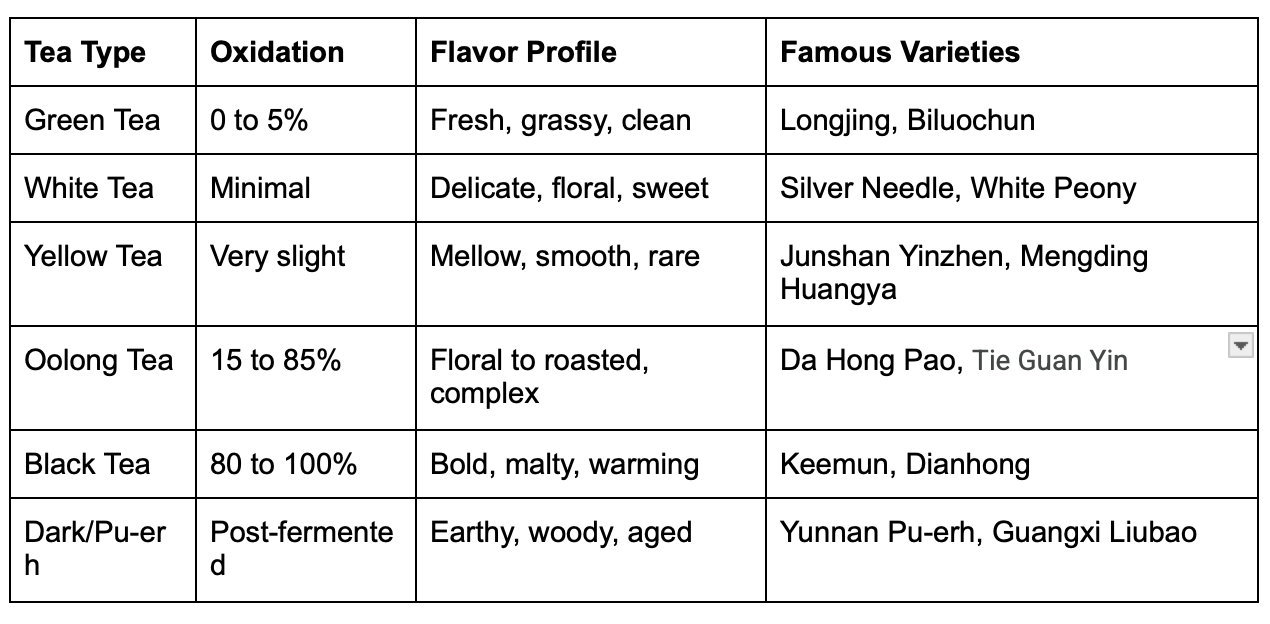
Quick Comparison: The Six Types at a Glance
Which Chinese Tea Should You Start With?
If you're completely new to Chinese tea, Longjing green tea or a Keemun black tea are excellent entry points. They're approachable, widely available, and give you a clear sense of the two ends of the spectrum.
Once you're comfortable, try an oolong. It's the category with the most variety and arguably the most fun to explore. And if you ever get curious about something deeper and more complex, track down a quality Pu-erh. It might just change the way you think about tea entirely.
Final Thoughts
Chinese tea isn't just a drink. It's a 3,000-year-old conversation between people, plants, and time. Every cup carries the influence of the season it was picked, the mountain it grew on, and the hands that processed it. The six categories give you a map to navigate all of that richness.
Whether you're sipping something new for the first time or returning to an old favorite, there's always something more to discover. And that's what makes Chinese tea culture so endlessly worth exploring.
Want to go deeper? Look up the traditional Chinese Gongfu tea ceremony, the ritual way of preparing and serving tea, and you'll find that the experience goes far beyond just the cup.
Share this article