
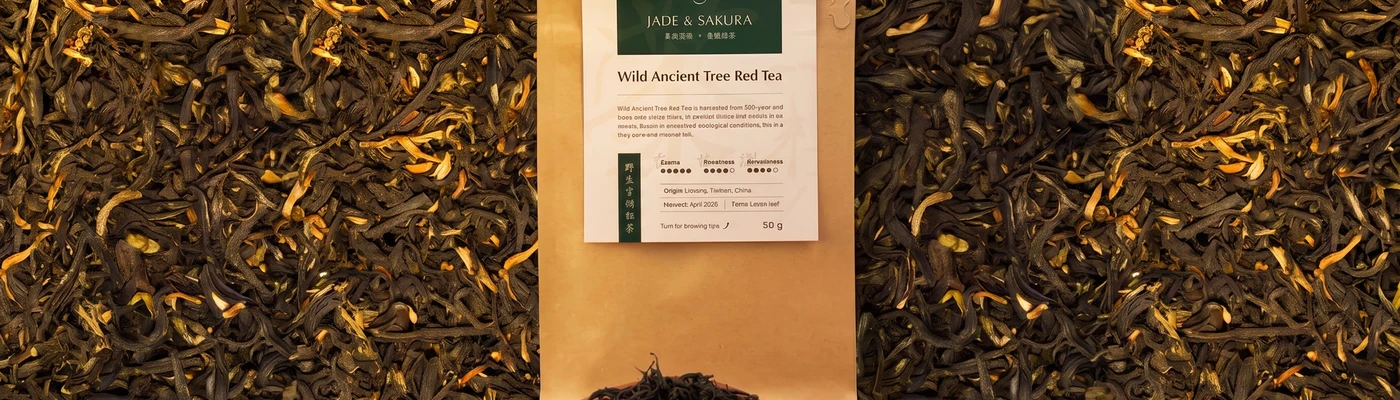
- Chinese black tea
- loose leaf black tea UAE
- Chinese red tea
Chinese Black Tea Loose Leaf in the UAE
Most people in the UAE who drink black tea daily have never actually tasted Chinese black tea. What they know is Assam in a teabag, or a generic breakfast blend that sits in the kitchen without a clear origin on the label. Chinese black tea, or hong cha as it is called in China, is a different thing entirely. It is where all black tea in the world began, and the loose leaf varieties available today carry a character that no blended teabag can come close to matching. This guide covers what Chinese black tea is, the main varieties worth knowing, how they taste, and how to find genuine loose-leaf options in the UAE.
The Naming Difference You Need to Know First
In China, fully oxidized tea is called hong cha, which means red tea. The name describes the warm amber-red color of the brewed liquid, not the dry leaves. When British traders encountered this tea in the 17th century, they named it after the color of the dry leaves, which are dark, and called it black tea.
This means that Chinese red tea and Chinese black tea are the same thing, and both terms lead you to the same product. Knowing this matters when searching for loose-leaf Chinese black tea in the UAE because you will find it listed under both names, depending on the seller. It also explains why Chinese tea menus and Chinese sellers consistently use red tea terminology while Western brands call identical teas black tea.
:strip_icc():strip_exif()/0001-01KJ0QQDGQ6TVNQXDS4MTVSCMC.png)
2024 Prickly Pear Red Tea
110 AED
Where Chinese Black Tea Comes From
Black tea originated in China, and specifically in the Wuyi Mountains of Fujian Province during the mid-17th century. A tea called Lapsang Souchong was the first fully oxidized tea ever produced, and every other black tea in the world, including Assam, Darjeeling, Ceylon, and every breakfast blend, traces its production methods back to the techniques developed in Fujian.
Today, Chinese loose-leaf black tea is produced across several southern provinces, each producing distinct varieties shaped by their local cultivars, climate, and processing traditions. Fujian, Anhui, and Yunnan are the three most significant regions for premium loose leaf varieties, and understanding what each region produces gives you a clear framework for navigating what is available in the UAE.
The Main Varieties Worth Knowing
There are four Chinese black teas that appear consistently on any serious list: Lapsang Souchong, Keemun, Dianhong, and Jin Jun Mei. Each comes from a different region, has a different flavor profile, and serves a different kind of drinker. There is also a useful saying among experienced tea drinkers that captures them neatly: for aroma, choose Keemun; for sweetness, choose Dianhong; for aftertaste, choose Lapsang Souchong; for freshness, choose Jin Jun Mei.
Lapsang Souchong, known in Chinese as Zheng Shan Xiao Zhong, is the oldest black tea in the world and the starting point for everything else. It comes from Tongmu Village in the Wuyi Mountains of Fujian Province, where it was accidentally created in the mid-1600s when tea farmers were forced to abandon their leaves during a military conflict. Returning to spoiled material, they dried the leaves over burning pine wood to salvage the batch, accidentally producing a tea with a distinctive smoky, pine-resinous aroma unlike anything that had existed before. Dutch traders bought it, and the global black tea trade began.
Traditional Lapsang Souchong carries that signature smoke: not sharp or harsh but warm, like a gentle campfire with a base of dried fruit and a honey note underneath. There is also a lightly fruity, longan-like quality that sits beneath the smoke in well-made batches. An unsmoked version called Zheng Shan Xiao Zhong without smoke drying is also produced and has a cleaner, fresher character closer to a light Keemun.
Keemun, or Qimen Hong Cha, comes from Qimen County in Anhui Province and is the only Chinese black tea to appear on China's official list of the ten most famous teas. It was first produced in 1875 by Yu Quianchen, a former government official who had studied tea production in Fujian before returning to Anhui. The tea he developed has a distinctive aromatic profile that the international tea community refers to as Keemun fragrance, a layered quality of orchid, dried rose, honey, and sometimes a hint of ripe apple that distinguishes it from every other black tea in the world. The liquor is a deep, warm red, smooth, full-bodied, and naturally sweet with no astringency. The British Royal Family has historically favored it, and it forms the backbone of many classic English breakfast blends.
Dianhong, or Yunnan Red Tea, was developed in 1939 by tea scientist Feng Shaoqiu, who worked with Yunnan's native large-leaf cultivar (Camellia sinensis var. assamica) to produce a black tea during wartime when traditional production areas in eastern China were disrupted. The result was a tea unlike anything from Fujian or Anhui: bold, naturally sweet, and noticeably malty with a chocolate and honey character. High-grade Dianhong is distinguished by abundant golden tips, the oxidized young buds that turn warm gold rather than dark brown and signal premium quality. The flavor is direct and satisfying, often described as a naturally rich sweetness with almost no bitterness. It is one of the most versatile Chinese black teas, excellent for drinking straight, with milk, or as a cold brew.
Jin Jun Mei, which means golden beautiful eyebrow, is the modern premium expression of the Wuyi red tea tradition. Created in 2005 by a Tongmu Village tea maker named Jiang Yuanxun, it uses only the finest spring buds from wild tea trees in the Wuyishan Nature Reserve, requiring around 58,000 hand-picked buds to produce one kilogram of finished tea. The result is a tea with a delicate, refined character quite different from the boldness of Dianhong or the smoke of Lapsang Souchong. The brewed liquor is a clear golden-red, the aroma is floral and faintly fruity, and the taste is light, clean, and lingering with a natural sweetness and no bitterness whatsoever. Jin Jun Mei is a tea for slow, attentive drinking and commands premium prices that reflect the extraordinary labor involved in its production.
:strip_icc():strip_exif()/WL_Longjing_2025_3-01KN21XBCMFEQJRXFDT3SB00FN.png)
2025 West Lake Longjing (Dragon Well) Green Tea
From 45 AED
Why Loose Leaf Matters for Chinese Black Tea
The difference between a quality Chinese black tea in loose leaf form and the same category in a teabag is not subtle. It is fundamental.
Teabags are almost universally filled with broken leaves or fannings, the smallest fragments left over after the better-quality whole leaves have been separated out. These fragments have more surface area exposed to air, which means they oxidize faster during storage and brew more quickly in water but with less complexity and more bitterness. They are designed for speed and convenience rather than flavor.
Loose-leaf Chinese black tea uses whole or large pieces of leaves that retain their essential oils, aromatic compounds, and natural sugars in a much more intact state. When these leaves open fully in hot water, which they cannot do inside the confined space of a teabag, they release their flavor gradually and across multiple infusions. A good loose-leaf Keemun gives five to seven Gongfu infusions, each one slightly different. A teabag gives one, and that one is a fraction of what the same leaves could produce if given room to work.
This is why Chinese black tea culture is almost entirely loose leaf in its traditional form. The whole leaf is the point.
Health Properties Worth Knowing
Chinese loose-leaf black tea is fully oxidized, which transforms the catechins present in green and white teas into different compounds called theaflavins and thearubigins. These polyphenols are specific to fully oxidized tea and have been studied for their effects on cardiovascular health, cholesterol management, and circulation support.
The caffeine content of Chinese black tea, typically 40 to 70mg per 240ml cup, combined with L-theanine, produces a focused, sustained energy that is noticeably different from coffee. The theanine moderates the way caffeine affects the nervous system, producing alertness without anxiety. Many people who find coffee too harsh on the stomach find that a quality loose-leaf Chinese black tea, which is naturally lower in astringency and bitterness than Indian black teas, is a workable daily substitute.
In traditional Chinese medicine, black tea is warm in nature and associated with warming the stomach, supporting circulation, and strengthening overall constitution. It is generally recommended during colder seasons or for people who tend to run cold.
How to Brew Chinese Black Tea at Home
Gongfu brewing with a small gaiwan or clay teapot of around 100 to 150ml produces the best results. Use 5 grams of loose leaf tea per 100ml of water. Water temperature should be 90 to 95 degrees Celsius for most Chinese black teas. Jin Jun Mei and delicate Keemun benefit from slightly lower temperatures around 85 to 90 degrees, while Lapsang Souchong and Dianhong handle the higher end well.
A quick rinse, five seconds, then discard, is optional but helps open the leaves and prepares them for the first proper infusion. First infusion: 15 to 20 seconds only. Pour completely and drink. Add 10 seconds per round. Good loose-leaf Chinese black tea gives five to eight comfortable infusions.
For Western-style brewing, use 3 grams per 200ml, steep for two to three minutes at 90 degrees Celsius, and drink with or without milk. Dianhong in particular holds up well to milk and is considered one of the finest natural milk tea bases among all Chinese teas.
Filtered or still bottled water makes a real difference. Dubai's treated tap water flattens the aromatic character of a quality Keemun or Dianhong noticeably.
Final Thoughts
Chinese loose-leaf black tea is where the entire global black tea tradition began, and the varieties available today carry several centuries of accumulated knowledge about how to grow, harvest, and process a tea leaf into something genuinely worth drinking slowly.
Whether you start with the bold sweetness of a Dianhong, the layered fragrance of a Keemun, or the deeply distinctive smoke of a Lapsang Souchong, the loose leaf format is what lets you experience what these teas are actually capable of. That difference is real, and it is worth finding out for yourself.
Share this article